Clinically reviewed by Monaghan Medical: October 5, 2026
Microplastics have been detected in air, water, food, and household dust, increasing awareness of the many ways people may be exposed to small plastic particles. For individuals who rely on respiratory therapy, this raises a more specific question: could repeated use, cleaning, or normal operation of a nebulizer or airway clearance device introduce plastic particles into the medication aerosol or airflow they breathe? Environmental studies cannot answer that question on their own. Evaluating a particular device requires product-specific testing.
Microplastics have become a familiar health and environmental topic, with new findings continuing to generate news coverage. Headlines about researchers detecting small plastic particles in places they never expected are becoming the norm, but those findings are often difficult to translate into decisions about medical care. Therefore, it is understandable that individuals who rely on nebulizers, valved holding chambers, or airway clearance devices may wonder whether these products could release particles during use.
While environmental research helps scientists understand where exposure may occur, testing the breathing gas pathway of medical devices addresses a different and more direct question: do they emit particulate matter into the gas stream that reaches the lungs?
What Are Microplastics?
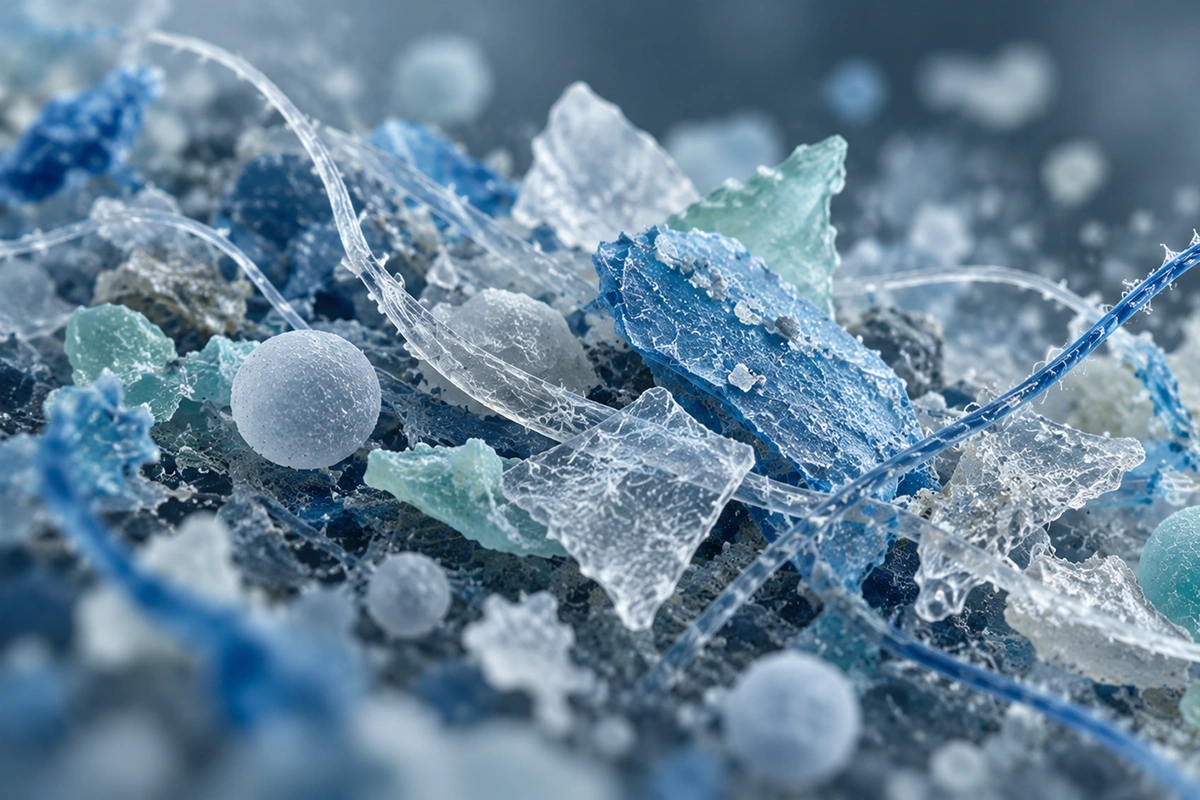
Microplastics are generally defined as any plastic particle smaller than 5 millimeters. The term covers many polymers in different shapes and sizes rather than one uniform substance. Some particles are manufactured at a small size. Others form when larger plastic items, synthetic textiles, tires, and other materials wear or break down.
People may encounter microplastics through food, drinking water, indoor and outdoor air, and dust. Inhalation is therefore one possible route of environmental exposure. The amount and type of exposure can vary widely, which is one reason broad headlines can’t definitively answer questions about a specific medical device.

What Research Says About Microplastics and Lung Health
The size, shape, composition of inhaled particles, along with the amount inhaled, can affect where they deposit in the respiratory tract and how the body responds. Laboratory and exposure studies have raised questions about inflammation and other biological effects, but researchers do not yet have enough human evidence to define the health risk associated with typical environmental exposure.1
In 2022, the World Health Organization published an assessment of the available evidence on dietary and inhalation exposure to nano- and microplastic particles. Its assessment identified substantial gaps in exposure data and in the evidence needed to characterize potential health risks. Health Canada has likewise described the health effects of microplastics as an emerging area of research and is funding studies of exposure through air, dust, food, water, and food packaging.
The key distinction: Detecting microplastics in the environment or in a human sample does not show that a particular respiratory device released them. That question requires testing of the device itself.
Research findings also need to be interpreted in context. A laboratory study may examine particle concentrations or exposure conditions that do not reflect everyday device use. A study that detects particles can establish their presence, but it does not automatically identify the source or demonstrate a clinical effect. These distinctions matter when patients and clinicians evaluate claims about respiratory device safety.
| Type of evidence | What it can tell us | What it cannot establish by itself2 |
|---|---|---|
| Environmental monitoring | Whether microplastics are detected in air, water, food, or dust | Whether a particular medical device released those particles |
| Human sample studies | Whether particles have been detected in samples such as lung tissue | The particles’ source or whether they caused a specific health effect |
| Laboratory and toxicology studies | How cells or biological systems may respond under controlled exposure conditions | The health risk associated with typical everyday exposure |
| ISO 18562-2 testing | Whether particulate matter enters a device’s respirable gas stream under specified test conditions | The chemical composition of every particle or the complete absence of all microscopic particles |
| Repeated-cleaning evaluation | Whether a reusable device maintains its integrity and performance after its expected cleaning cycles | The effects of cleaning methods not included in the device’s Instructions for Use |
| Manufacturing and material controls | How materials, component cleanliness, and production processes are controlled | A substitute for testing the finished device |
Environmental monitoring
What it can tell us
Whether microplastics are detected in air, water, food, or dust
What it cannot establish by itself2
Whether a particular medical device released those particles
Human sample studies
What it can tell us
Whether particles have been detected in samples such as lung tissue
What it cannot establish by itself2
The particles’ source or whether they caused a specific health effect
Laboratory and toxicology studies
What it can tell us
How cells or biological systems may respond under controlled exposure conditions
What it cannot establish by itself2
The health risk associated with typical everyday exposure
ISO 18562-2 testing
What it can tell us
Whether particulate matter enters a device’s respirable gas stream under specified test conditions
What it cannot establish by itself2
The chemical composition of every particle or the complete absence of all microscopic particles
Repeated-cleaning evaluation
What it can tell us
Whether a reusable device maintains its integrity and performance after its expected cleaning cycles
What it cannot establish by itself2
The effects of cleaning methods not included in the device’s Instructions for Use
Manufacturing and material controls
What it can tell us
How materials, component cleanliness, and production processes are controlled
What it cannot establish by itself2
A substitute for testing the finished device
How Respiratory Devices Are Evaluated for Particulate Emissions
A respiratory device’s breathing gas pathway is the route followed by air or gas through the equipment toward the patient. Because that pathway can carry material directly to the respiratory tract, it is evaluated separately from the device’s exterior surfaces.
ISO 18562-2 is the international standard for testing particulate matter emitted from the breathing gas pathways of medical devices, parts, and accessories used in respiratory care. The 2024 edition covers particles from 0.25 to 10 micrometers that enter the respirable gas stream. The standard evaluates particles by size rather than by chemical composition, so it is broader than a test for plastic particles alone. Note: the ISO 18562-2 standard does not address nanoparticles smaller than 0.25 micrometers because sufficient data are not yet available to establish exposure limits for that size range.
A passing result means the tested device met the standard’s applicable acceptance criteria under the specified conditions. It does not mean that a test can prove the complete absence of every particle or identify every particle’s chemistry. This is an important limitation, but it is also why ISO 18562-2 is relevant: it measures particulate emissions in the pathway that matters for respiratory use.
How Monaghan Medical Evaluates Its Respiratory Devices
Monaghan Medical uses several forms of evaluation and process control to address the questions patients and clinicians may have about particles and device materials.
- Particulate emissions testing. AeroEclipse® II BAN® Nebulizers, AeroEclipse® XL R BAN® Nebulizers, Aerobika® OPEP, the AeroChamber Plus® Flow-Vu® AVHC, and AeroChamber2Go® devices have all passed ISO 18562-2 testing. The results show that these devices meet the applicable particulate-emissions criteria.
- Testing after repeated cleaning. Reusable devices are expected to be cleaned many times. Lifecycle evaluations repeat the cleaning methods stated in the device Instructions for Use for the expected number of cycles, followed by inspection and additional performance testing. Our evaluated reusable devices maintain material integrity and expected performance under those conditions.
- Material and manufacturing controls. All Monaghan Medical devices are assembled in a controlled environment, using proprietary polymers, with all components inspected for cleanliness before assembly.
- No intentionally added microbeads. Our product components and proprietary materials contain no intentionally added synthetic polymer microparticles or microbeads as defined by Entry 78 of the European Union’s REACH restriction. Please note: the Entry 78 statement addresses synthetic polymer microparticles intentionally added to product materials. It does not replace particulate-emissions testing, which evaluates particles that could enter the breathing gas pathway during use.
| Evaluation area | Monaghan Medical approach | Why it matters |
|---|---|---|
| Particulate emissions | Applicable devices are evaluated according to ISO 18562-2 | Tests the breathing gas pathway through which air or aerosol reaches the patient |
| Repeated cleaning | Reusable devices are evaluated after the expected number of cleaning cycles described in their Instructions for Use | Helps assess material integrity and performance throughout the intended service life |
| Materials and manufacturing | Components are inspected for cleanliness and devices are assembled in a controlled cleanroom environment | Supports consistent finished-device quality |
| Intentionally added microbeads | Product components and materials do not contain intentionally added synthetic polymer microparticles or microbeads as defined by the cited REACH restriction | Distinguishes material formulation from particulate-emissions testing |
Particulate emissions
Monaghan Medical approach
Applicable devices are evaluated according to ISO 18562-2
Why it matters
Tests the breathing gas pathway through which air or aerosol reaches the patient
Repeated cleaning
Monaghan Medical approach
Reusable devices are evaluated after the expected number of cleaning cycles described in their Instructions for Use
Why it matters
Helps assess material integrity and performance throughout the intended service life
Materials and manufacturing
Monaghan Medical approach
Components are inspected for cleanliness and devices are assembled in a controlled cleanroom environment
Why it matters
Supports consistent finished-device quality
Intentionally added microbeads
Monaghan Medical approach
Product components and materials do not contain intentionally added synthetic polymer microparticles or microbeads as defined by the cited REACH restriction
Why it matters
Distinguishes material formulation from particulate-emissions testing
What This Means for Patients and Clinicians
For individuals and clinicians that use these products, the important point is that device safety is evaluated based on the finished product and how it is intended to be used. For the Monaghan Medical devices evaluated, particulate emissions were assessed using a recognized standard for breathing gas pathways. Reusable devices were also evaluated after the number of cleaning cycles expected during their intended service life.
These findings provide product-specific reassurance when the devices are used and maintained according to their instructions for use. The presence of plastic in a medical device does not, by itself, establish a microplastics risk. Device safety depends on the finished product, its materials, how it is manufactured, how it performs over time, and whether it is used and cleaned as directed.
Using and Cleaning Your Device Safely
Always follow the Instructions for Use supplied with your specific device. Cleaning and replacement directions are not interchangeable across products, even when the devices look similar. Use only the methods approved for your model, allow components to dry as directed, inspect reusable parts, and replace the device or component at the recommended interval.
Do not stop or change prescribed respiratory therapy because of a general report about microplastics. If you have questions about a particular device, ask your healthcare professional or contact the manufacturer for product-specific information.
A Product-Specific Approach Provides the Clearest Answer
Microplastics research will continue to develop. For respiratory care today, the most relevant evidence is the evidence tied to the device being used. Particulate-emissions testing, lifecycle evaluation after repeated cleaning, and manufacturing controls provide a practical basis for assessing a device rather than drawing conclusions from environmental findings alone.
If you have questions about a Monaghan Medical device, please consult your healthcare professional, or contact us directly for additional product information: 800-833-9653
Frequently Asked Questions
Are microplastics present in the air?
Research has identified indoor and outdoor air and dust as potential sources of microplastic exposure. Scientists are still working to understand typical exposure levels and what those exposures may mean for human health.
Does a plastic respiratory device automatically release microplastics?
No. The presence of plastic components does not establish that a finished device releases particles into its breathing gas pathway. Product-specific emissions testing is needed to evaluate that pathway.
What does it mean when a device passes ISO 18562-2 testing?
It means the tested device met the standard's acceptance criteria for particulate emissions under the specified conditions. The standard evaluates particulate matter in the respirable gas stream by particle size, regardless of chemical composition.
Can I use a different cleaning method to reduce microplastics?
Use only the cleaning and disinfection methods listed in the Instructions for Use for your device. An unapproved method may damage a component or affect device performance. If the instructions are unclear, contact our customer service team at 800-833-9653 or your healthcare professional for assistance.
Should I stop using my respiratory device because of microplastics?
Do not stop prescribed treatment without speaking with your healthcare professional. General environmental research cannot determine the performance of a specific medical device. Product-specific testing and correct use provide a more appropriate basis for that discussion.
Citations:
1. Vattanasit, U., Kongpran, J., & Ikeda, A. (2023). Airborne microplastics: A narrative review of potential effects on the human respiratory system. Science of the Total Environment, 904, 166745. https://doi.org/10.1016/j.scitotenv.2023.166745
2. U.S. Food and Drug Administration, Center for Devices and Radiological Health. Weight-of-Evidence Approach for Assessing Microplastic and Nanoplastic (MNP) Emissions from Medical Devices. US Department of Health and Human Services; 2024.