The Heirarchy of Evidence
Respiratory care continues to evolve as new research, technologies and treatment approaches become available. But not every study, claim, recommendation, or personal experience carries the same weight. Understanding the quality of the evidence, how it was developed, and whether it is appropriate for the question being asked can help clinicians, patients, and caregivers make more informed decisions.
Experience ≠ Evidence. Data ≠ Strong Evidence. Publication ≠ Proof.
Understanding the difference means looking beyond the claim to the quality, methods, and context of the evidence behind it.
What Is Evidence-Based Respiratory Care?
Evidence-based medicine combines the best available research evidence with clinical expertise and the individual patient’s values and preferences to help guide care decisions. It does not replace clinical judgment; it provides a stronger foundation for applying that judgment to patient care. Evidence can come from systematic reviews, randomized controlled trials, observational research, laboratory studies, and clinical experience, but each provides a different type and level of evidence.
As pictured here, stronger study designs generally provide greater confidence when they are appropriate to the research question and conducted well. However, position within the hierarchy alone does not determine whether evidence is useful. The right evidence depends on the question being asked. This hierarchy of evidence is widely used in evidence-based healthcare to help distinguish among different types and strengths of research, including in respiratory care.
The Right Evidence for the Right Question
Different questions require different sources of evidence. A clinical trial may help determine whether a therapy improves patient outcomes, while validated manufacturer instructions are the appropriate source for how a specific medical device should be used, cleaned or disinfected.
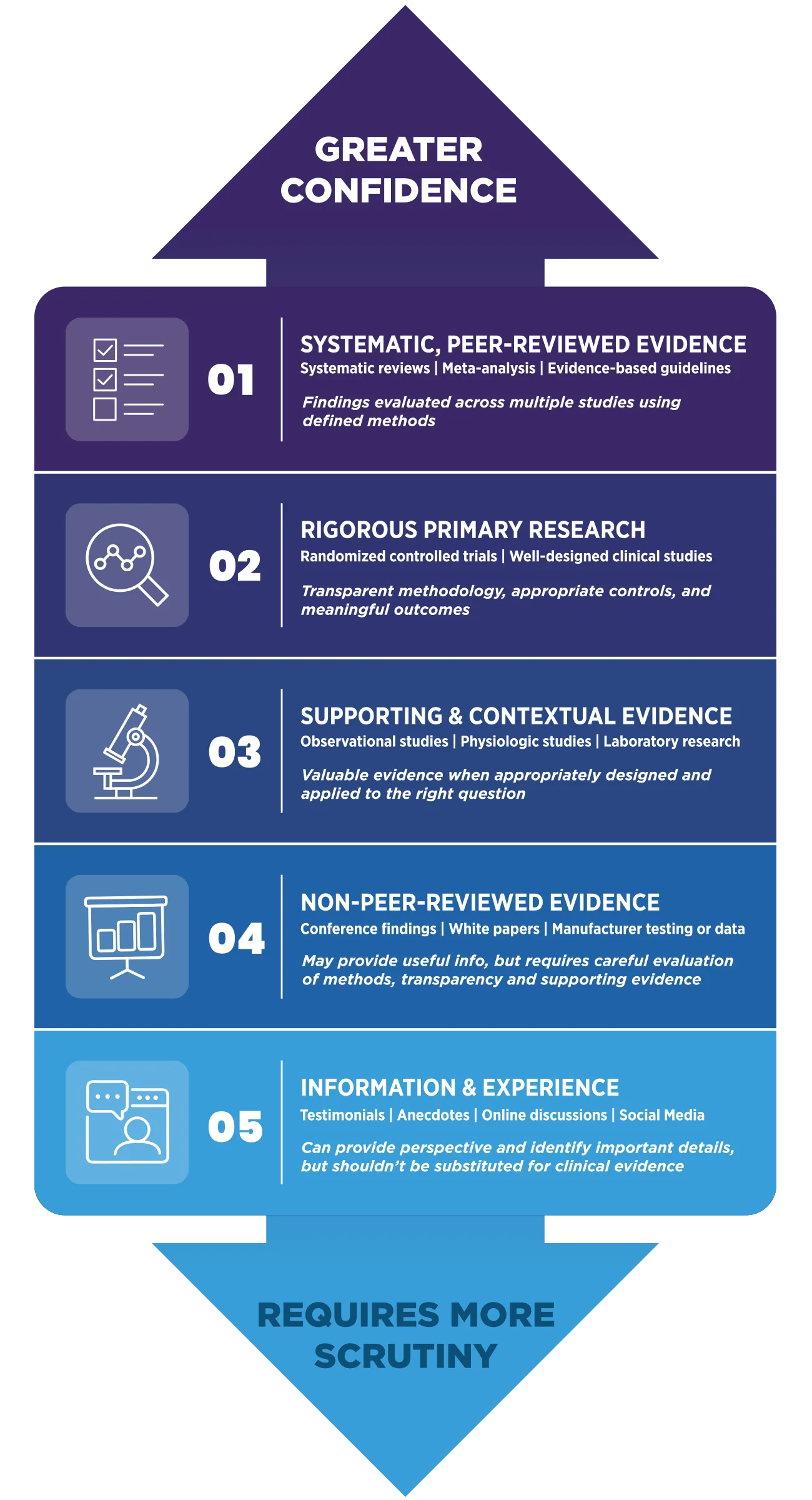
Click the image to enlarge.
| Question: | Most Appropriate Source: |
|---|---|
| Does respiratory therapy improve patient outcomes? | High-quality clinical research, systematic reviews, and evidence-based clinical practice guidelines |
| How does a respiratory device perform under controlled conditions? | Appropriately designed laboratory or bench research using recognized testing methods and relevant standards |
| How should a specific medical device be used, cleaned, or disinfected? | The manufacturer’s current Instructions for Use and other validated product instructions |
| Should I begin, stop, or change a treatment? | A qualified healthcare professional who can apply the available evidence to the individual patient’s circumstances |
| What is it like to live with a respiratory condition or use a therapy in everyday life? | Patient communities and individual experiences can provide valuable perspective and support |
| Does one person’s experience prove that a treatment works or does not work? | No. Individual experiences can identify questions worth exploring, but they cannot by themselves establish clinical efficacy or safety. |
High-quality clinical research, systematic reviews and evidence-based clinical practice guidelines
Appropriately designed laboratory or bench research using recognized testing methods and relevant standards
The manufacturer’s current Instructions for Use and other validated product instructions
A qualified healthcare professional who can apply the available evidence to the individual patient’s circumstances
Patient communities and individual experiences can provide valuable perspective and support
No. Individual experiences can identify questions worth exploring, but they cannot by themselves establish clinical efficacy or safety.
What Makes Research Trustworthy?
High-quality research uses methods appropriate to the question, takes steps to reduce bias, and clearly reports what was tested, how it was tested, and how conclusions were reached. Peer review adds another layer of scientific scrutiny, but publication does not make a study flawless.
Confidence grows when methods are transparent, limitations and potential conflicts are disclosed, and findings can be evaluated or reproduced by other qualified researchers. This is particularly important when comparing medical devices. A claim that one device “performed better” than another has limited meaning if the testing methods, conditions, outcomes or analysis are not sufficiently described.
What About Manufacturer-Sponsored Research?
Medical-device research often requires specialized equipment, technical expertise, and financial resources, so manufacturers may fund or support research involving their technologies. This is not unique to medical devices; pharmaceutical companies routinely fund the clinical research required to establish the safety and efficacy of new medications. The key is transparency: funding sources and potential conflicts should be clearly disclosed, and the methods and results should be reported in enough detail to allow independent scrutiny and, where appropriate, replication. Sponsorship alone does not determine whether a study is valid. It’s important to ask how the research was designed, whether appropriate methods and comparisons were used, whether the findings underwent peer review, and whether other qualified researchers can evaluate or reproduce the work.
Strong evidence should withstand scrutiny regardless of who provided financial or technical support for the research.
Before You Trust a Respiratory-Care Claim
Whether information comes from a published paper, product comparison, educational resource, presentation, social media post, or any other source, asking a few questions can help put the claim into context.
| Ask This Question | Why It Matters |
|---|---|
| What is the original source? | Peer-reviewed research, clinical guidelines, manufacturer reports, testimonials and social media posts represent different types of information. |
| What type of evidence supports the claim? | The evidence should be appropriate for the conclusion being made. |
| Who conducted and funded the research? | Funding, author relationships and potential conflicts should be transparently disclosed. |
| Are the methods appropriate and clearly described? | Readers should be able to understand how testing was performed and whether recognized methods or standards were followed. |
| Are the outcomes meaningful? | A measurable or statistically significant difference is not necessarily clinically important. |
| Was the work peer reviewed, and are its limitations disclosed? | Scientific scrutiny and transparent limitations help readers judge what a study can reasonably establish. |
| Have the findings been reproduced or supported by other research? | Confidence increases when findings are replicated or supported by the broader body of evidence. |
Peer-reviewed research, clinical guidelines, manufacturer reports, testimonials and social media posts represent different types of information.
The evidence should be appropriate for the conclusion being made.
Funding, author relationships and potential conflicts should be transparently disclosed.
Readers should be able to understand how testing was performed and whether recognized methods or standards were followed.
A measurable or statistically significant difference is not necessarily clinically important.
Scientific scrutiny and transparent limitations help readers judge what a study can reasonably establish.
Confidence increases when findings are replicated or supported by the broader body of evidence.
Social Media, Personal Experience, and Respiratory Care
Online communities can provide valuable support and allow patients and caregivers to share their experiences. But experience and evidence are not interchangeable. Advice shared online may apply to a different person, product or circumstance, and information does not become scientifically validated simply because it is widely shared.
For questions about treatment, you should always consult your healthcare provider. For instructions about the operation, cleaning, disinfection, or care of a specific medical device, please follow the Instructions for Use or contact our customer care team at (800) 833-9653.
Monaghan Medical’s Commitment to Evidence
Research is essential to understanding respiratory-device performance and advancing patient care. When Monaghan Medical supports research involving our devices, that relationship is disclosed, and the evidence should be evaluated using the same principles applied to other research: methodology, transparency, appropriate analysis, peer review where applicable, reproducibility and consistency with the broader body of evidence – because confidence in respiratory care should be built on evidence that can withstand scrutiny.
Evidence Should Inform, Not Simply Persuade
No claim should be accepted simply because it appears in a publication, comes from a manufacturer, is recommended by an influential individual, or has been repeated throughout an online community. Ask where the information came from. Look at how the research was conducted. Consider whether the evidence actually supports the conclusion being made.
Frequently Asked Questions
What is the hierarchy of evidence in respiratory care?
The hierarchy of evidence is a framework for evaluating different types of research. Systematic reviews and well-designed clinical trials generally provide greater confidence for clinical questions, while observational research, laboratory studies and individual experiences provide different types of evidence that may be appropriate for different questions.
Does manufacturer-sponsored research count as credible evidence?
Manufacturer sponsorship does not automatically make research credible or unreliable. Funding and potential conflicts should be disclosed, while the research itself should be evaluated based on its methodology, transparency, appropriate analysis, peer review where applicable, reproducibility and consistency with other evidence.
Is personal experience considered medical evidence?
Personal experience can provide valuable insight and may identify questions worth studying, but an individual's experience cannot by itself establish that a treatment or medical device is safe or effective for others.